

Climate Change and Wildfire Smoke Top Canadians’ Disaster Concerns as Weather Worries Shift Regionally
First Onsite’s Weather and Property Survey highlights Canada’s regional weather and property worries
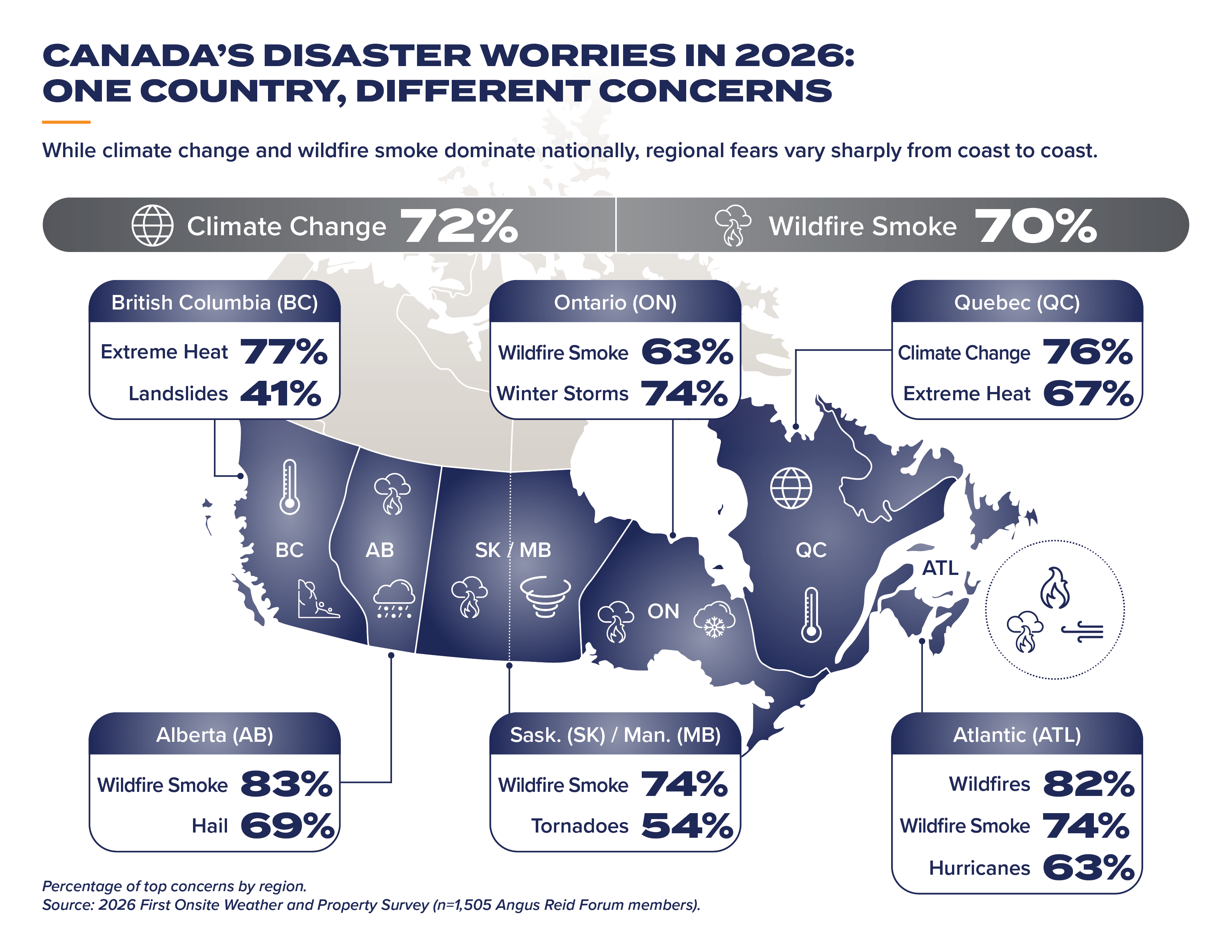
MISSISSAUGA, Ontario, March 11, 2026 (GLOBE NEWSWIRE) -- Despite a winter marked by record extremes—from historic snowstorms and deep freezes to unseasonably mild stretches—Canadians’ overall disaster concerns have modestly declined. According to First Onsite Property Restoration’s annual Weather and Property survey, concerns surrounding severe weather events such as winter storms, flooding, hurricanes, and more have softened by five points or more year-over-year (see Table 1).
These findings follow a year where Canada saw a significant drop in insured losses—falling from a record-breaking $9.4 billion in 2024 to $2.4 billion in 2025, according to Catastrophe Indices and Quantification Inc. (CatIQ). While this decrease might offer a temporary sense of relief, 2025 still ranked as the tenth costliest year on record. The largest weather events that occurred throughout 2025, including the Ontario and Quebec ice storms, the Flin Flon and La Ronge wildfires, the Calgary hailstorm, the Prairie’s severe storm, and B.C.’s series of atmospheric rivers, prove that risks remain high.
Although some weather concerns have eased, the past two decades of intensifying weather events and insured losses are keeping Canadians on high alert. Indeed, climate change remains a defining concern across the country. Seventy-two per cent of Canadians are worried about being affected by climate change, and seven-in-10 worry that climate change is already driving up the cost of their home or business insurance. Additionally, wildfire smoke has also emerged as one of the top overall concerns for businesses and homeowners nationwide, with 70 per cent reporting being concerned.
Most notably, Canadians aren’t becoming desensitized to disaster—they’re becoming more in tune to the impacts of climate-related disasters in their respective regions of the country.
“In our eighth year conducting this survey, we’re seeing clearer regional differences emerge, with specific concerns about being impacted by weather events evident in the various provinces and regions across Canada,” said Jim Mandeville, senior vice president, large loss North America at First Onsite Property Restoration. “Canadians are now laser-focused on the specific regional risks that have and will continue to impact their homes and businesses the most, making the conversation around climate change and property damage more personal than ever.”
What matters most: A regional breakdown
When examining regional trends, British Columbia reported the highest level of concern in the country regarding extreme heat/heat domes (77%), as well as landslides/mudslides (41%) and severe rainfall and flooding (70%). This is particularly significant as we approach the five-year anniversary of the devastating 2021 summer heat dome and wildfires, followed by November’s atmospheric river and Pacific Northwest floods that same year, which severely impacted the province and broader region.
Alberta led the country in hail concerns (69%). This is not surprising, as southern Alberta is known as Canada’s “Hailstorm Alley,” and the province is less than two years removed from the devastating 2024 Calgary hailstorms—one of Canada’s costliest natural disasters. It also led the country in concern about wildfire smoke (83%) and tied B.C. in greatest concerns about wildfires (79%), which is a reminder of the challenges facing the province as it approaches the 10-year anniversary of the destructive Fort McMurray wildfires.
Manitoba and Saskatchewan trailed the country in concern regarding climate change (56%). Their highest areas of concern were wildfire smoke (74%), winter storms (71%), and extreme cold and freezing (67%). That said, the provinces did lead the country in concerns about tornadoes or severe winds (54%).
Ontario’s top concerns were climate change (74%), winter storms (74%), and extreme cold/freezing (69%). However, the biggest change was wildfire smoke, which saw a 10-point increase year-over-year to 63 per cent. This was likely influenced by the wildfire smoke air quality alerts that placed Toronto among the top 10 most polluted cities in the world last August.
Québec’s top concerns were climate change (76%), extreme heat/heat domes (67%), wildfire smoke (65%), severe rains and flooding (62%), and extreme cold and freezing (60%). In 2025, Québec was particularly impacted by a major late-winter ice storm, summer flooding, and a severe wildfire season.
Despite leading the country by a healthy margin (63%), Atlantic Canada saw a 10-point dip in hurricane concern, following a relatively inactive hurricane season. However, wildfire and wildfire smoke concerns rose sharply by 15 points and 13 points, respectively. This is unsurprising considering last year’s wildfires in Newfoundland, Nova Scotia, New Brunswick, and Prince Edward Island.1
See the table below for the results of Canada’s top disaster concerns.
| TABLE 1: Canada’s top disaster concerns for |
Total 2025 |
Total 2026 |
B.C. 2026 |
AB 2026 |
MB/SK 2026 |
ON 2026 |
QC 2026 |
ATL 2026 |
||||||||
| Climate change | 73 | % | 72 | % | 75 | % | 62 | % | 56 | % | 74 | % | 76 | % | 76 | % |
| Winter storms | 71 | % | 66 | % | 53 | % | 70 | % | 71 | % | 74 | % | 55 | % | 77 | % |
| Extreme cold and freezing | 68 | % | 63 | % | 48 | % | 64 | % | 67 | % | 69 | % | 60 | % | 61 | % |
| Severe rains and flooding | 66 | % | 61 | % | 70 | % | 52 | % | 49 | % | 63 | % | 62 | % | 56 | % |
| Wildfire smoke | 65 | % | 70 | % | 82 | % | 83 | % | 74 | % | 63 | % | 65 | % | 74 | % |
|
Wildfires |
63 | % | 63 | % | 79 | % | 79 | % | 66 | % | 52 | % | 60 | % | 82 | % |
| Tornadoes or severe winds | 58 | % | 47 | % | 33 | % | 48 | % | 54 | % | 49 | % | 49 | % | 53 | % |
| Landslides/mudslides | 26 | % | 22 | % | 41 | % | 14 | % | 11 | % | 18 | % | 24 | % | 26 | % |
| Extreme heat/heat dome | N/A | 67 | % | 77 | % | 60 | % | 54 | % | 68 | % | 67 | % | 59 | % | |
| Hurricanes and tropical storms | 31 | % | 26 | % | 24 | % | 12 | % | 13 | % | 25 | % | 29 | % | 63 | % |
| Hail | N/A | 46 | % | 28 | % | 69 | % | 53 | % | 46 | % | 42 | % | 42 | % | |
Source: First Onsite Property Restoration and Angus Reid
The path forward
“The growing frequency and severity of weather-related events continue to highlight the importance of resilience for homeowners, businesses, and communities,” said Mandeville. “With thoughtful planning and the right resources, people can be better prepared to manage property emergencies when they occur.”
First Onsite offers free preparedness guides to help businesses and property owners manage risks from natural disasters and severe weather.
In Canada, First Onsite has been on the frontlines of high-risk situations due to climate change, natural disasters, and weather-related events for 19 years. It has been on site at some of the country’s most severe catastrophes of flooding, wildfires, tornadoes, hurricanes, and extreme cold.
About the First Onsite Weather and Property Survey
These findings are from a survey conducted by First Onsite Property Restoration from February 20th to February 23rd, 2026, among a representative sample of 1505 online adult Canadians who are members of the Angus Reid Forum. The survey was conducted in English and French. For comparison purposes only, a probability sample of this size would carry a margin of error of +/-2.53 percentage points, 19 times out of 20.
About First Onsite: North America’s Trusted Leader in Property Restoration
First Onsite Property Restoration is one of the largest and fastest-growing emergency response planning, mitigation, and reconstruction service providers in North America. First Onsite employs over 2,500 team members and operates from more than 100 locations across Canada and the U.S. With a culture focused on harnessing the human power of its team members and a commitment to doing what’s right, the First Onsite team helps clients restore, rebuild, and rise. First Onsite is a subsidiary of FirstService Corporation. For more information, go to firstonsite.ca or follow First Onsite on LinkedIn.
PRESS CONTACT:
Sierra LeBlanc
MAVERICK Public Relations
647-405-2196
sierra@wearemaverick.com
1 https://www.canada.ca/en/environment-climate-change/services/top-ten-weather-stories/2025.html
A photo accompanying this announcement is available at https://www.globenewswire.com/NewsRoom/AttachmentNg/c13c052e-c2c1-4083-978c-c6a385c8aa88


CANADA'S DISASTER WORRIES IN 2026.
CANADA'S DISASTER WORRIES IN 2026. ONE COUNTRY, DIFFERENT CONCERNS.
Legal Disclaimer:
EIN Presswire provides this news content "as is" without warranty of any kind. We do not accept any responsibility or liability for the accuracy, content, images, videos, licenses, completeness, legality, or reliability of the information contained in this article. If you have any complaints or copyright issues related to this article, kindly contact the author above.
