

Non-GMO Food Market Forecast to Hit US$ 129.9 Bn by 2033 | Persistence Market Research
non-GMO food market
The non-GMO food market is expanding due to growing demand for clean-label products, ingredient transparency, health awareness, and trusted certifications.
LONDON, UNITED KINGDOM, June 15, 2026 /EINPresswire.com/ -- The global non-GMO food market is entering a period of sustained expansion, supported by rising consumer interest in transparent ingredient sourcing and healthier dietary choices. Industry estimates indicate the market will be valued at US$ 76.3 billion in 2026 and is projected to reach US$ 129.9 billion by 2033, reflecting a compound annual growth rate (CAGR) of 7.9% during the forecast period. Growing scrutiny of genetically modified ingredients continues to influence purchasing decisions across both developed and emerging economies.
Download Your Free Sample & Explore Key Insights: https://www.persistencemarketresearch.com/samples/35269
Certification and Regulatory Support Strengthen Market Growth
Certification programs have become a major growth catalyst, strengthening consumer trust and encouraging broader adoption of non-GMO products. The expansion of recognized verification systems has improved product credibility while helping shoppers identify food and beverage items that meet specific sourcing and production standards. At the same time, mandatory GMO labeling regulations in key markets are increasing transparency and prompting manufacturers to expand non-GMO product portfolios.
Consumer Awareness Drives Category Expansion
Market growth is being supported by heightened consumer attention to food safety and ingredient quality. Surveys indicate that a large share of consumers regularly review product labels before making purchasing decisions, with non-GMO claims ranking among the most influential factors. This shift in consumer behavior has encouraged both established manufacturers and private-label retailers to broaden their non-GMO offerings across multiple categories.
Premium Pricing Remains a Key Challenge
Despite positive momentum, affordability remains a significant challenge. Non-GMO products often carry higher prices due to certification requirements, supply chain segregation, and verification costs. Studies suggest that non-GMO labeled products can command premiums of 20% to 30% compared with conventional alternatives in several categories. These higher prices may limit adoption in price-sensitive markets, particularly among lower-income consumers.
Food Segment Continues to Dominate
By product type, the food segment is expected to dominate the market with an estimated 57% share in 2026. Demand is being driven by growing consumer concerns regarding genetically modified crops commonly used in processed foods, snacks, cereals, baked goods, and frozen products. As a result, many consumers are increasingly seeking certified alternatives that align with clean-label preferences.
Get Custom Insights Designed for Your Businecss: https://www.persistencemarketresearch.com/request-customization/35269
Beverage Category Records Strong Growth
The beverage segment is projected to register the fastest growth rate during the forecast period. Rising interest in plant-based milks, functional beverages, kombucha, juices, and herbal drinks is creating new opportunities for manufacturers. Millennials and Generation Z consumers, in particular, are demonstrating strong demand for products that combine health benefits with transparent ingredient sourcing and non-GMO verification.
Online Retail Expands Market Reach
From a distribution perspective, supermarkets and hypermarkets are expected to remain the leading sales channel, supported by broad product visibility and extensive shelf space. However, online retail is emerging as a major growth avenue. Digital platforms allow consumers to compare products, review ingredient information, and access a wider range of non-GMO options, making e-commerce an increasingly important part of the market landscape.
North America Retains Market Leadership
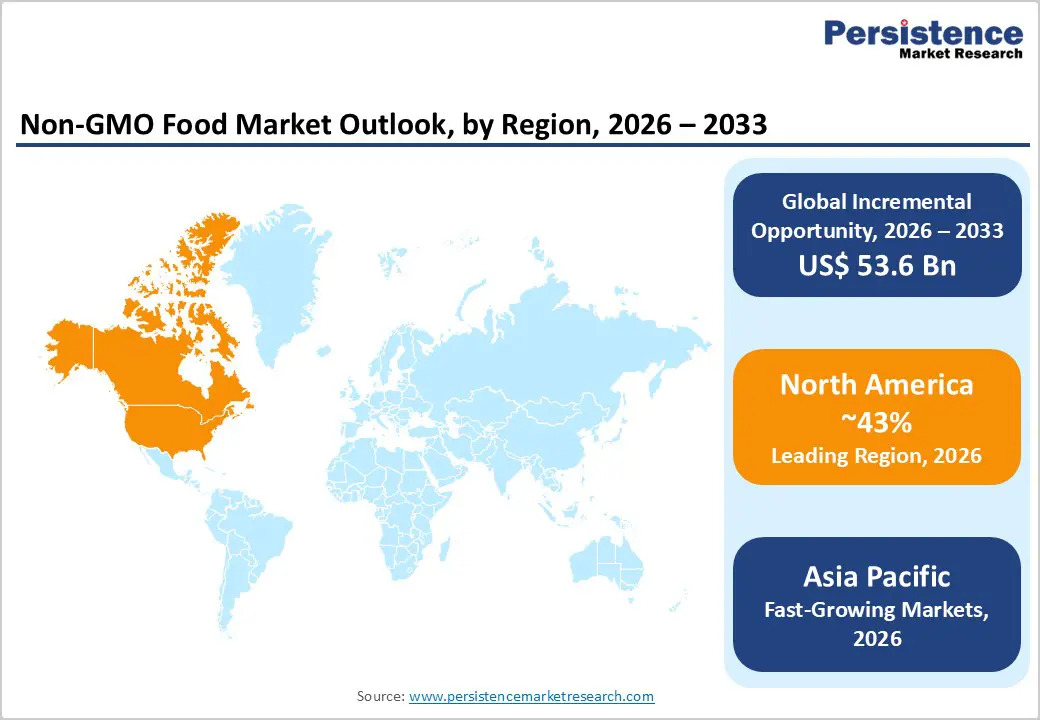
North America remains the leading regional market, accounting for approximately 43% of global revenue in 2025. The region benefits from a mature certification ecosystem, strong consumer awareness, and widespread demand for clean-label products. Food companies across the United States and Canada continue to invest in ingredient traceability and transparent labeling, helping reinforce market leadership and supporting long-term category growth.
Asia Pacific Emerges as the Fastest-Growing Region
Asia Pacific is expected to record the fastest growth through 2033. Rising urbanization, increasing disposable incomes, and growing health awareness among middle-class consumers are driving demand for non-GMO food products. Expanding e-commerce grocery platforms in countries such as India and China are improving product accessibility, while regulatory developments in Japan and South Korea are encouraging greater transparency in food labeling practices.
Market Segmentation
By Product Type
Beverage
Food
By Distribution Channel
Supermarkets/Hypermarkets
Convenience Stores
Online Retail Stores
Others
By Regions
North America
Europe
East Asia
South Asia & Oceania
Latin America
Middle East & Africa
Checkout Now & Download Complete Market Report: https://www.persistencemarketresearch.com/checkout/35269
Competitive Landscape and Future Outlook
The competitive environment remains moderately fragmented, with multinational corporations and specialty brands competing across various price points and distribution channels. Companies are focusing on certification, supply chain transparency, and digital engagement to strengthen brand positioning. Recent product launches and investments in e-commerce capabilities further highlight the sector’s growth potential. As consumer demand for transparency and natural ingredients continues to rise, the non-GMO food market is expected to maintain strong momentum through 2033.
Read Related Reports:
Date Syrup Market: The Date Syrup Market size is valued at US$ 502.1 Bn in 2026 & projected to reach US$ 765.0 Bn by 2033, growing at a CAGR of 6.2% from 2026 to 2033.
Functional Fruit Market: The global functional fruit market size is likely to grow from US$ 12.7 billion in 2026 to US$ 21.5 billion, projected to record a CAGR of 7.8%.
Persistence Market Research
Persistence Market Research Pvt Ltd
+1 646-878-6329
email us here
Visit us on social media:
LinkedIn
Instagram
Facebook
YouTube
X
Legal Disclaimer:
EIN Presswire provides this news content "as is" without warranty of any kind. We do not accept any responsibility or liability for the accuracy, content, images, videos, licenses, completeness, legality, or reliability of the information contained in this article. If you have any complaints or copyright issues related to this article, kindly contact the author above.
