

Originality.ai Launches Next-Generation AI Detection Models to Tackle Mixed Human-AI and Humanized Writing
5.0 accuracy
The most advanced and accurate AI detector for mixed and humanized AI writing.
As AI becomes more integrated into the writing process, the way people want to understand AI involvement is changing. These models aim to meet that industry need.”
COLLINGWOOD, ONTARIO, CANADA, October 20, 2026 /EINPresswire.com/ -- As generative AI becomes more sophisticated, the challenge of identifying AI-written content is evolving. AI-generated text can now be extensively edited, rewritten, or processed through AI humanizer tools designed to make it resemble human writing. At the same time, human and AI contributions are becoming increasingly intertwined, raising new questions about originality, authorship, and transparency in education, publishing, and professional content creation.— Jon Gillham
Against this backdrop, Originality.ai, a Canadian AI detection company, has launched 5.0 and 5.0 Max, its most accurate AI detection models to date. The new models are designed to address one of the industry's growing challenges: identifying AI involvement in documents that combine human-written, AI-generated, and humanized content.
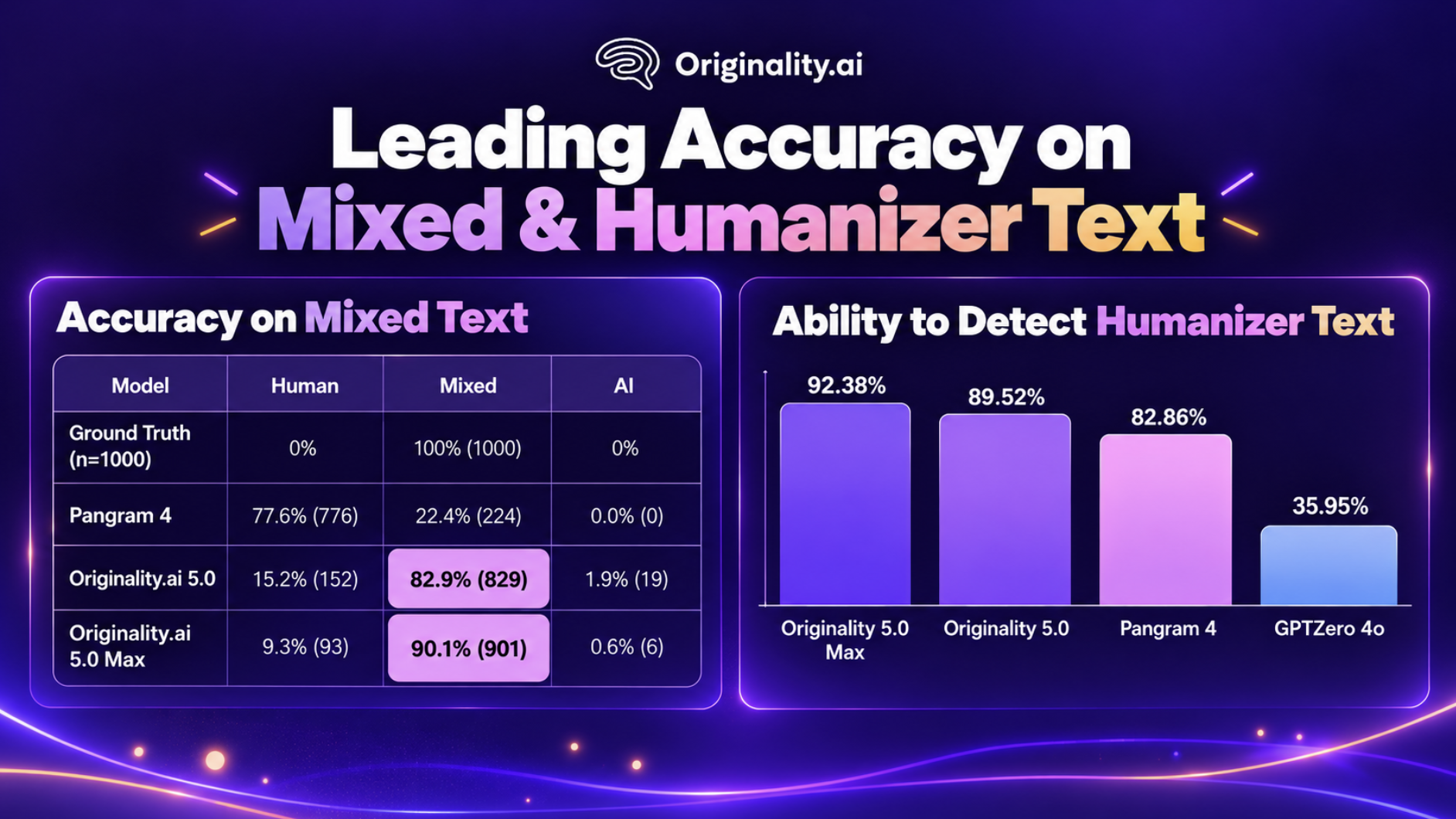
In testing conducted by Originality.ai using 1,000 mixed-writing documents from OpAI-Bench, 5.0 Max correctly classified 90.1% of documents as mixed writing, compared with 82.9% for 5.0.
Why Mixed Human-AI Writing Is Changing AI Detection:
Earlier approaches to AI detection largely focused on distinguishing entirely human-written documents from AI-generated text. But modern writing workflows rarely fit neatly into either category.
A student might use AI to develop an essay outline before writing and editing the final submission. A marketing team might substantially rewrite an AI-generated draft. A publisher might encounter content processed through AI humanizer software intended to obscure its machine-generated origins.
These scenarios create challenges for organizations responsible for evaluating the authenticity and originality of written work.
For educators, the issue extends beyond detecting AI use to assessing independent thinking and student learning. For publishers and businesses, it raises questions about editorial integrity, transparency, and the authenticity of expert commentary.
The emergence of mixed and humanized writing has also increased the importance of AI detectors capable of providing more nuanced assessments rather than simple binary classifications.
A New Approach to Identifying AI Involvement:
Originality.ai's 5.0 and 5.0 Max models introduce a revised scoring system designed to help reviewers better interpret potential AI involvement.
Rather than relying on the confidence-based scoring used in previous models, the new AI checker categorizes content into three classifications:
Likely Original: Content assessed as predominantly human-written.
Mixed Writing: Content showing indicators of both human and AI-generated writing.
Likely AI: Content assessed as predominantly AI-generated.
The models also introduce improved sentence-level highlighting, allowing reviewers to examine specific passages that may warrant additional scrutiny.
An optional feature called Deep Scan provides further explanations of why certain text may have been flagged, alongside suggestions to support editing.
Together, these features reflect a shift toward AI detection tools that provide more context about potential AI involvement rather than relying solely on an overall document score.
Balancing Detection Accuracy, Speed, and Scale:
The launch includes two models designed for different content review requirements.
Originality.ai 5.0 prioritizes faster processing and lower scanning costs, making it suitable for routine reviews and organizations assessing large volumes of content.
Originality.ai 5.0 Max prioritizes the company's highest available detection accuracy, with longer processing times and higher credit costs for reviews where accuracy is the primary consideration.
Both models automatically identify the language of submitted content and support AI detection across more than 30 languages, alongside code detection capabilities.
Despite advances in detection technology, identifying AI-generated content remains an imperfect process. Accuracy can vary depending on the language, writing style, content type, and extent of human editing or AI humanization.Originality.ai emphasizes that AI detection results should inform further human review rather than serve as definitive evidence of authorship or academic misconduct.
Availability
Originality.ai 5.0 and 5.0 Max are available through the company's web application, Bulk Scan, Chrome and Firefox browser extensions, API, MCP integration, and Moodle.
More information is available at https://originality.ai.
Jonathan Gillham
Originality.ai
Visit us on social media:
LinkedIn
Facebook
YouTube
TikTok
Originality.ai 5.0 and 5.0 MAX are Here! Our Most Accurate AI Detector & AI Checker Yet
Legal Disclaimer:
EIN Presswire provides this news content "as is" without warranty of any kind. We do not accept any responsibility or liability for the accuracy, content, images, videos, licenses, completeness, legality, or reliability of the information contained in this article. If you have any complaints or copyright issues related to this article, kindly contact the author above.
